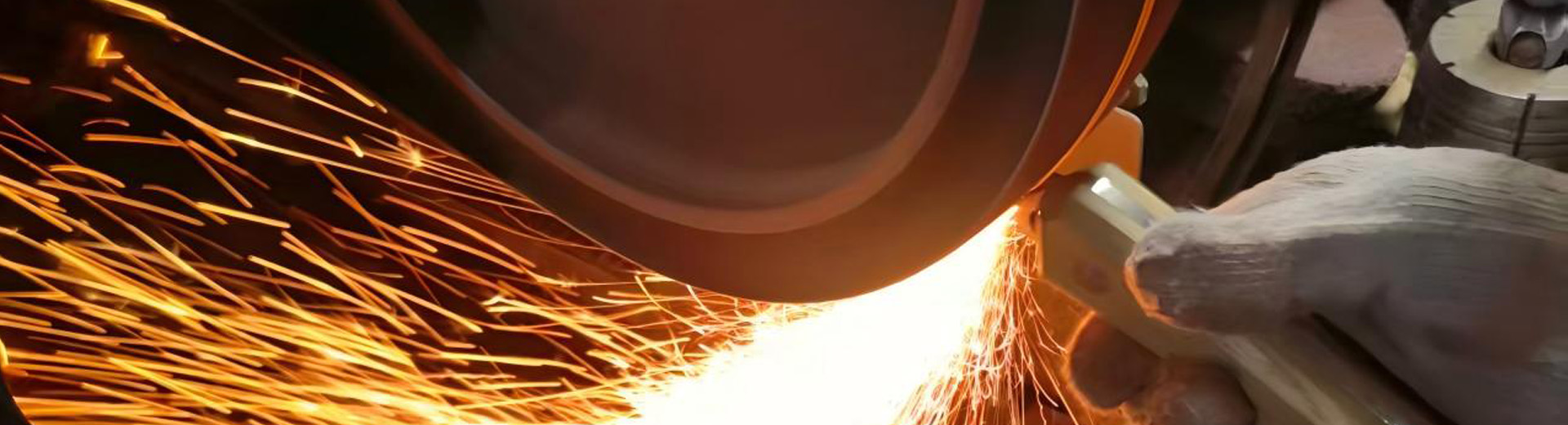
Have you ever wondered how sanding belts are made?
To most users, a sanding belt is just a consumable tool. But behind it lies a highly engineered manufacturing process that directly determines:
Cutting performance
Lifespan
Heat resistance
Consistency in industrial grinding
As a professional sanding belt manufacturer, we’ll walk you through the real production process step by step, so you can understand what separates high-quality belts from low-end products.
For industrial metal grinding, the most common choice is:
Y-weight polyester cloth backing
High tensile strength
Resistant to tearing under high pressure
Stable during high-speed grinding
A weak backing leads to belt breakage — no matter how good the abrasive grain is.
Next, a resin adhesive layer is applied to the backing.
This layer is critical because it:
Holds the abrasive grains
Determines bonding strength
Affects heat resistance
High-end sanding belt manufacturers use advanced resin systems to improve durability.
This is one of the most important steps.
Abrasive grains (ceramic, zirconia, aluminum oxide) are applied using electrostatic coating.
Grains are electrically charged
They stand upright on the backing
Sharp edges face outward
✔ Better cutting performance
✔ More aggressive grinding
✔ Longer lifespan
Poor manufacturers often fail here — resulting in weak cutting ability.
A second resin layer (top coat) is added to:
Lock the grains in place
Improve heat resistance
Increase durability
This step determines how well the belt performs under heavy grinding conditions.
The coated material is then cured in an oven.
Harden the resin
Stabilize the structure
Improve bonding strength
Proper curing ensures the belt can handle:
✔ High temperature
✔ High pressure
✔ Continuous operation
The large abrasive rolls are converted into belts.
This includes:
Cutting to size
Jointing (splicing)
Overlap joint
Butt joint
Tape joint
A high-quality joint ensures:
✔ Smooth running
✔ No vibration
✔ No breakage during use
Before shipping, professional sanding belt manufacturers perform strict checks:
Grain distribution uniformity
Joint strength
Flexibility
Dimensional accuracy
This step ensures consistent performance batch after batch.
From a technical perspective, quality depends on:
Ceramic → highest performance
Zirconia → balanced performance
Strong resin = longer lifespan
Y-weight backing for heavy-duty use
Especially electrostatic coating and curing
A well-made sanding belt will:
✔ Cut faster
✔ Last longer
✔ Generate less heat
✔ Reduce downtime
Poor-quality belts:
❌ Wear quickly
❌ Require more pressure
❌ Increase cost per part
Choosing the right sanding belt manufacturer is critical for industrial buyers.
If you are looking for:
Ceramic sanding belts (high-performance grinding)
Zirconia sanding belts (cost-effective alternative)
Heavy-duty Y-weight backing
Stable production quality
Explore our products here:
https://www.liyingsandbelt.com/
If you want to learn more about our sanding belt production or test samples:
Email: [email protected]
WhatsApp: +86 178 0585 0436
We support:
OEM manufacturing
Custom sizes and specifications
Fast delivery for bulk orders
So, how are sanding belts made?
Through a precise multi-step process:
Backing selection
Adhesive coating
Electrostatic grain application
Top coating
Heat curing
Cutting and jointing
Quality inspection
Every step directly affects performance.
In the end:
A sanding belt is only as good as the manufacturer behind it.